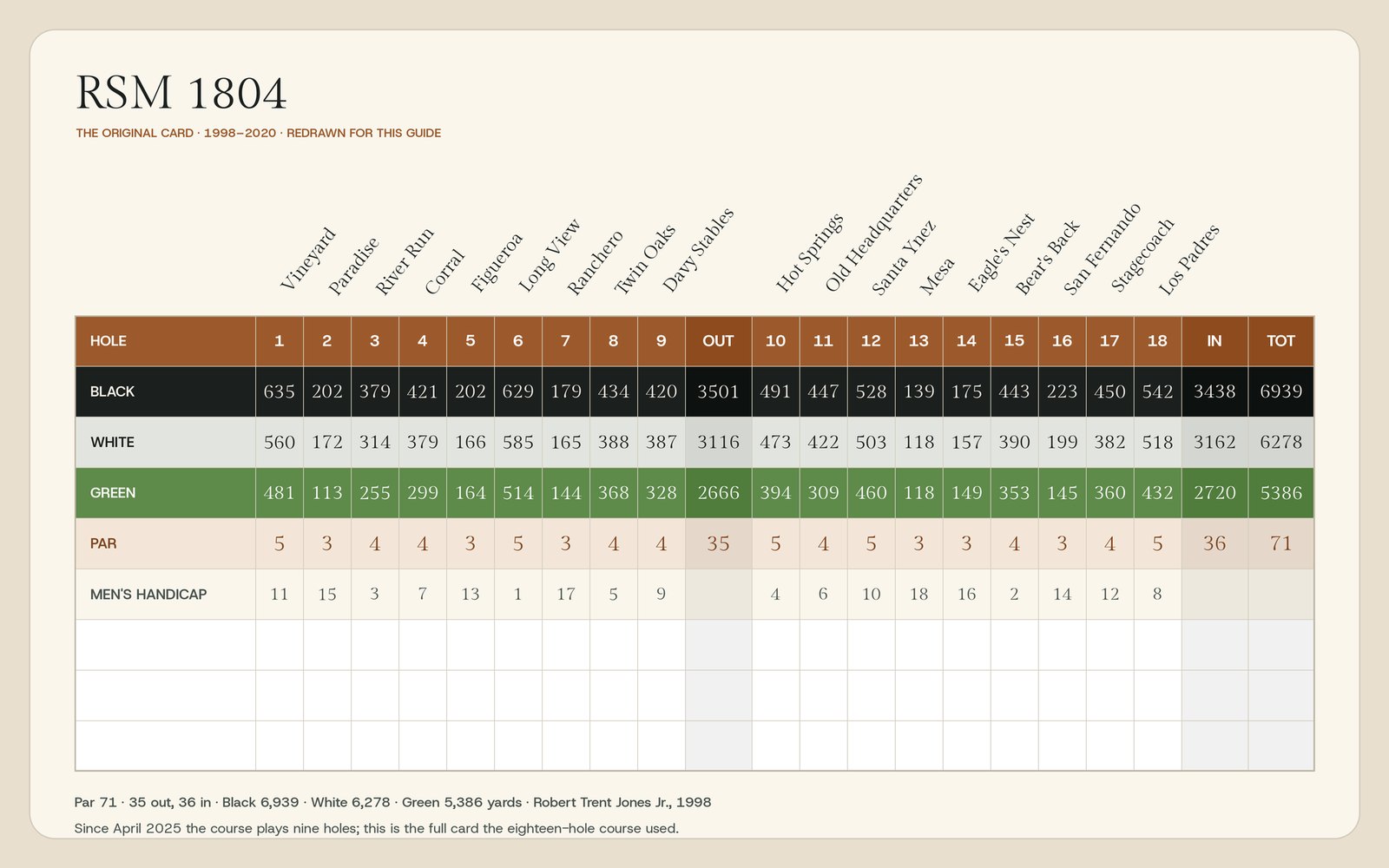
A scorecard is the shortest description of a golf course there is. The one for Rancho San Marcos fits 18 names, three tee lengths, a par and a handicap rank for each hole onto a folded card, and it still says a lot about how Robert Trent Jones Jr. built the course that opened in January 1998.
The card at a glance
The original card is a par 71: 35 on the front nine and 36 on the back. Totals by tee are:
- Black: 6,939 yards (front 3,501, back 3,438)
- White: 6,278 yards (front 3,116, back 3,162)
- Green: 5,386 yards (front 2,666, back 2,720)
The black tees are the championship set. The white tees are the everyday set for most adult players, and the green tees are the forward set. On the front nine the white and green totals sit 450 yards apart, on the back nine 442 yards apart.
The full 18-hole card
| Hole | Name | Par | Black / White / Green |
|---|---|---|---|
| 1 | Vineyard | 5 | 635 / 560 / 481 |
| 2 | Paradise | 3 | 202 / 172 / 113 |
| 3 | River Run | 4 | 379 / 314 / 255 |
| 4 | Corral | 4 | 421 / 379 / 299 |
| 5 | Figueroa | 3 | 202 / 166 / 164 |
| 6 | Long View | 5 | 629 / 585 / 514 |
| 7 | Ranchero | 3 | 179 / 165 / 144 |
| 8 | Twin Oaks | 4 | 434 / 388 / 368 |
| 9 | Davy Stables | 4 | 420 / 387 / 328 |
| 10 | Hot Springs | 5 | 491 / 473 / 394 |
| 11 | Old Headquarters | 4 | 447 / 422 / 309 |
| 12 | Santa Ynez | 5 | 528 / 503 / 460 |
| 13 | Mesa | 3 | 139 / 118 / 118 |
| 14 | Eagle’s Nest | 3 | 175 / 157 / 149 |
| 15 | Bear’s Back | 4 | 443 / 390 / 353 |
| 16 | San Fernando | 3 | 223 / 199 / 145 |
| 17 | Stagecoach | 4 | 450 / 382 / 360 |
| 18 | Los Padres | 5 | 542 / 518 / 432 |
Each hole is described in more detail, in playing order, on the Rancho San Marcos course tour.

How to read the handicap row
Beneath the yardages the card carries a men’s handicap rank for every hole, from 1 to 18. Rank 1 marks the hole that plays hardest relative to par; rank 18 the easiest. In match play a player who receives strokes takes them on the lowest-ranked holes first, so the row decides where those strokes fall.
At Rancho San Marcos the ranking puts the odd numbers on the front nine and the even numbers on the back, a common way to spread strokes over both halves. The five hardest holes are Long View (1), Bear’s Back (2), River Run (3), Hot Springs (4) and Twin Oaks (5). The five easiest are Mesa (18), Ranchero (17), Eagle’s Nest (16), Paradise (15) and San Fernando (14), all of them par 3s.
Today’s nine-hole card
The course reopened in April 2025 with nine holes in play. As listed by the course, the nine-hole card measures 3,501 yards from the back tees and 2,666 from the front, at par 35. Those numbers are the original front nine to the yard: Vineyard, Paradise, River Run, Corral, Figueroa, Long View, Ranchero, Twin Oaks and Davy Stables.
An 18-hole round today means playing the same nine twice, which the course sells as a replay. Prices for nine holes, the replay and carts are on the Rancho San Marcos green fees page. The general manager has said the course is expected to stay at nine holes, so the back nine on the card is best read as the record of the full course that ran from 1998 to 2020.
Front nine against back nine
The two halves of the card look similar on paper, 3,501 and 3,438 yards from the black tees, but they are built differently.
- Front nine (holes 1 to 9): par 35, three par 3s, two par 5s, 3,501 yards from the black tees.
- Back nine (holes 10 to 18): par 36, three par 3s, three par 5s, 3,438 yards from the black tees.
The front nine carries its length in two very long par 5s, Vineyard and Long View, which together account for more than a third of its yardage. The back nine spreads its length more evenly: three par 5s between 491 and 542 yards, the longest par 4 on the course at Old Headquarters, and the longest par 3 at San Fernando. A player who scores well on the front nine at Rancho San Marcos has usually managed those two long holes well.
Choosing a set of tees
The yardage gap between the tees is not even from hole to hole, which matters when a group mixes tee boxes. Some examples from the card:
- On hole 2, Paradise, the green tees play 89 yards shorter than the black.
- On hole 1, Vineyard, the green tees save 154 yards, the largest cut on the card; hole 11, Old Headquarters, is next at 138.
- On hole 5, Figueroa, and hole 13, Mesa, the white and green tees are within two yards of each other.
A simple rule many clubs use: pick the tees where a good drive leaves a mid or short iron on most par 4s. For a player who drives the ball around 200 yards, that usually means the green tees here; around 230 to 250 yards, the white.
Keeping score on the card
The card has room for each player’s gross score per hole, with OUT, IN and TOTAL columns. A few habits keep it clean:
- Write the score on the next tee, not on the green, to keep play moving.
- Mark strokes received with a dot on the handicap holes before the round starts.
- Record putts in a corner of the box if the group wants to track them.
For a match, many groups also note the running status (“1 up”, “all square”) under each hole. Formats such as the Nassau or skins read straight off the card, and the wider guide to golf betting games explains how each one is scored.
What the card says about the course
Read as a whole, the scorecard shows a course that front-loads its length and back-loads its variety. The two longest holes are both on the front nine, which is the nine in play now. The back nine has three shorter par 5s and back-to-back par 3s at 13 and 14. The names, from Vineyard to Los Padres, trace the ranch that stood here first; the story behind them is told in the history of Rancho San Marcos.